
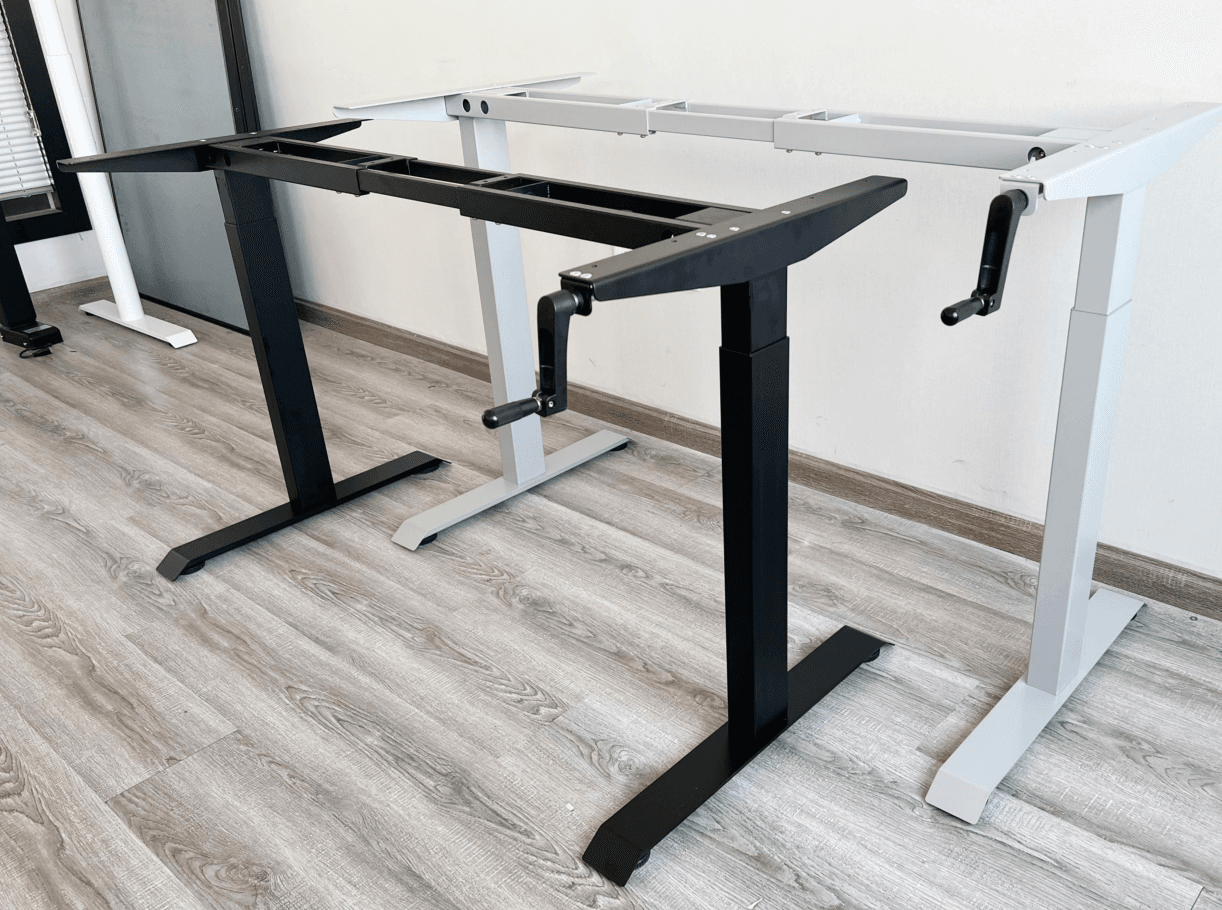
Quick Answer
When choosing a manual vs electric standing desk, we recommend electric adjustment wherever reliable power is available. At B&H Ergonomics, we still offer hand-crank desks, but very few of our customers choose them now. The saving over our economy single-motor option is small, while adjustment takes much longer and requires turning the handle by hand.
Last Updated: September 18, 2026 | Author: William | Estimated Reading Time: 4 minutes
How Manual and Electric Standing Desks Adjust
A hand-crank standing desk moves as you turn its handle. An electric desk moves through motor-driven adjustment controlled by a handset. With the manual option, you keep turning throughout the height change; with the electric option, you operate the height controls.
For a buyer comparing the two, the useful questions are how long that movement takes and how much the manual option actually saves.
How Long Does a Height Change Take?
Our hand-crank option adjusts at approximately 3 mm/s. Our BH-S22RS single-motor frame has a listed speed of 25 mm/s, while our BH-D23RS dual-motor frame with three-stage columns is listed at 32 mm/s.
| Our desk configuration | Speed used in calculation | Calculated time for 300 mm of travel |
|---|---|---|
| Hand-crank option | Approximately 3 mm/s | 100 seconds |
| BH-S22RS, single motor | 25 mm/s | 12 seconds |
| BH-D23RS, dual motor, three-stage columns | 32 mm/s | About 9.4 seconds |
Calculation: travel distance ÷ adjustment speed = travel time. These examples use our adjustment-speed figures to calculate travel time; they are not timed trials. Actual results depend on load and operating conditions, including turning pace for the hand crank. Check the quoted model’s speed conditions if loaded travel time is part of your purchase specification.
The 300 mm distance is an illustration. To estimate your own adjustment time, subtract your seated desktop height from your standing desktop height, then divide that distance by the relevant speed.
At the example distance, the hand-crank option requires around one minute and forty seconds of turning. The single-motor option takes twelve seconds at its listed speed. That is the main practical step up for a budget buyer. Moving from single to dual motor reduces the calculated time by a further 2.6 seconds for this particular movement; the rest of that purchase decision involves the complete frame configuration.
For a shared workstation, use the positions needed by the people assigned to it. A short adjustment between two seated users is a different movement from a full sitting-to-standing change.
Is the Manual Desk’s Lower Price Worth It?
We still offer hand-crank desks, but very few of our customers choose them now. The saving over our economy single-motor option is small, while raising or lowering the desk takes much longer and requires turning the handle by hand.
Compare the quoted difference in money with the movement you just calculated. A simple purchasing worksheet keeps both visible:
| Item to record | Your comparison |
|---|---|
| Manual quotation per workstation | __ |
| Electric quotation per workstation | __ |
| Additional cost for electric adjustment | Electric quote minus manual quote: __ |
| Number of workstations | __ |
| Additional cost for the order | Per-workstation difference × quantity: __ |
| Required height change | Standing height minus seated height: __ mm |
| Calculated travel time for each offered configuration | Required travel ÷ quoted speed: __ seconds |
| User’s decision after trying the crank | Acceptable / choose electric |
Use equivalent quotation scopes: the same desktop specification, finish, accessories, quantity and delivery basis. Both proposals must meet the required finished height range and equipment load. Record warranty and parts-support differences separately so they are visible in the decision.
The quoted saving is what you can measure financially. The calculated movement time helps the user judge convenience; it does not establish a productivity return or monetary payback.
When Is a Hand-Crank Desk a Practical Choice?
A manual desk can be adjusted without a power connection. That makes it useful where supplying electricity to the workstation is impractical.
Before ordering, have the intended user try the handle through the required travel with the planned desktop and equipment, within the desk’s load limit. Check that the handle clears nearby furniture and remains reachable. Record whether the user accepts the effort for the changes they expect to make.
A desk adjusted only occasionally may make that effort easier to accept. For daily position changes at a powered workstation, we recommend putting the budget toward electric adjustment.
For an electric installation, include a suitable power connection and enough cable travel in the plan. If these add installation costs, include them in the quotation comparison.
Which Electric Option Should You Compare First?
When budget is the reason you are considering a hand-crank desk, start by requesting an economy single-motor quotation. Check the offered model’s finished height range and moving-load rating before comparing the price.
If you are also considering our BH-D23RS, review our single-motor versus dual-motor frame comparison for the differences in structure, controls and working-height range. Choose the configuration that meets those requirements rather than paying for speed alone.
Explore our standing desk frames and send us your completed price-and-travel comparison, desktop specification and workstation quantity. Ask us to identify the exact model, height range and included controls in your quotation so you can match it to the configuration you evaluated.